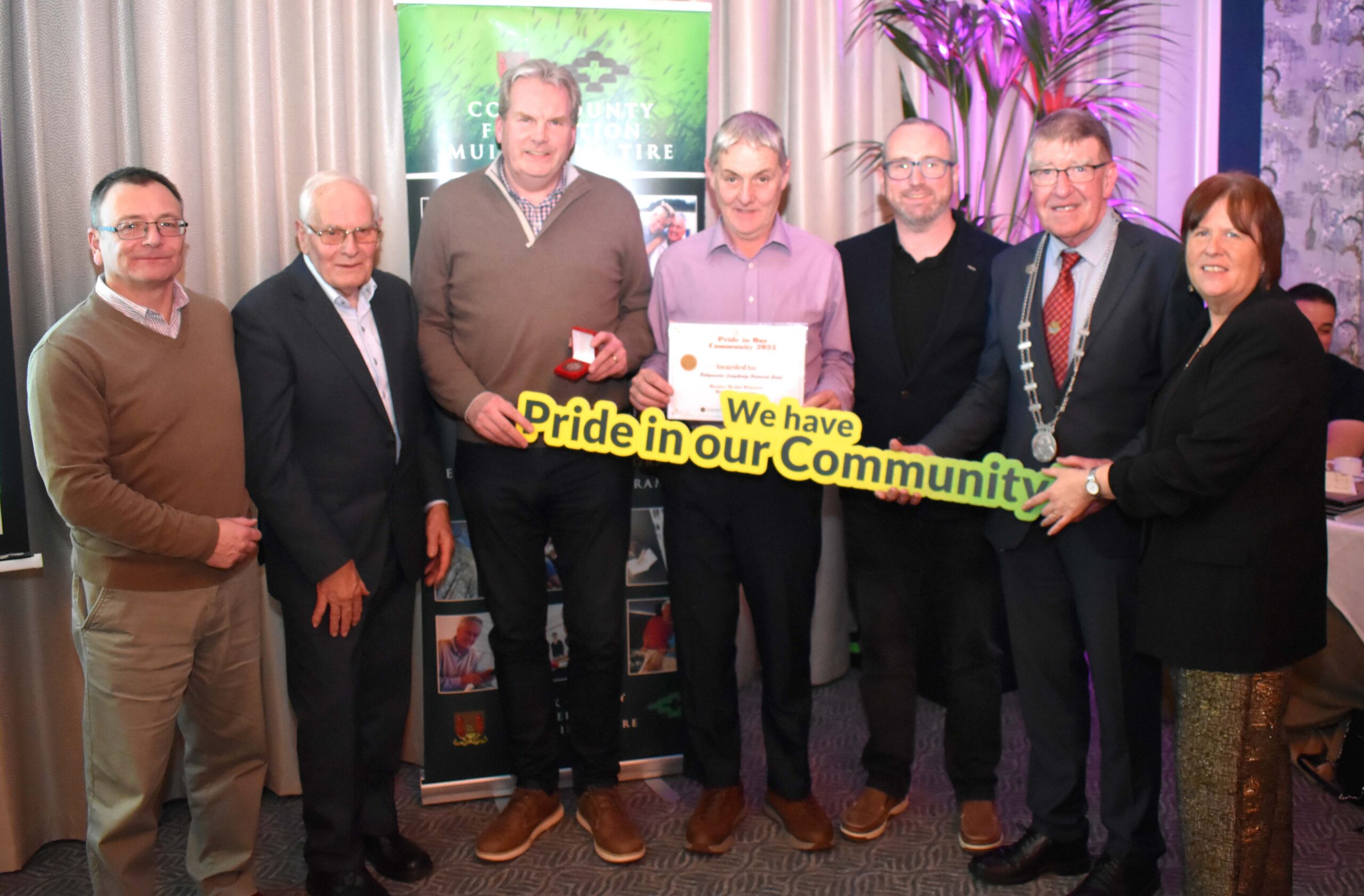
This project was made possible through funding from the Community Monuments Fund 2025, and we are deeply grateful to Cork County Council for their invaluable support. Their commitment to preserving and promoting our local heritage plays a vital role in enabling projects like this one, helping us protect our historical landscape and share its stories with the wider community.
CMF Grant Reference: CMF25-3-CO003
Introduction
For Senegalese environmentalist Baba Dioum ‘You can’t save a place you don’t love. You can’t love a place you don’t know. And you can’t know a place you haven’t learned…In the end we will conserve only what we love, we will love only what we understand; and we will understand only what we are taught’ (McLaren, 2024). This report, then, outlines the background to and rationale behind a BLCC Historical Group project to digitally and artistically reconstruct the C17th Tynte and Harris monuments in Kilcredan, Co. Cork, how we went about the process and some of the outcomes.
Rationale & Background to the Project
The Tynte and Harris monuments are of local, regional, national and international historical significance. The Tynte monument in particular, is listed as ‘Artefact 67’ in Cork County Council’s ‘Heritage Artefacts of County Cork’ (2021). It is listed on the Irish National Inventory of Architectural Heritage and has received sustained scholarly attention from Smith (1750), Maziere-Brady (1863), Lee (1926), Harris (1999) and Herron (2023).
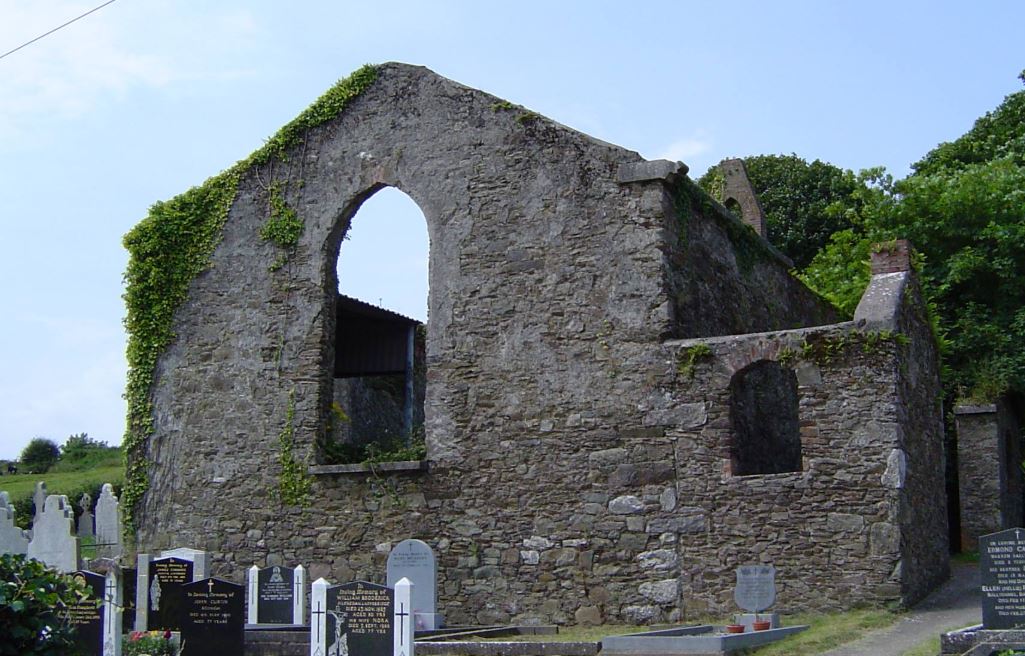
Most likely, the Tynte monument was created in England & then shipped to Ireland (Harris, 1999, p.144). Alternatively, the sculptor may have spent some time in England to become familiar with its ornamentation style. It was created after the death of Sir Robert Tynte’s second wife in 1622 but before his own in 1643. The monument was part of a wider project to transform a ruined medieval church in Kilcredan into east Cork’s first purpose-built Anglican parish church. The project was completed by 1636 when Kilcredan church was rebuilt and the Tynte and Harris monuments inserted into it.
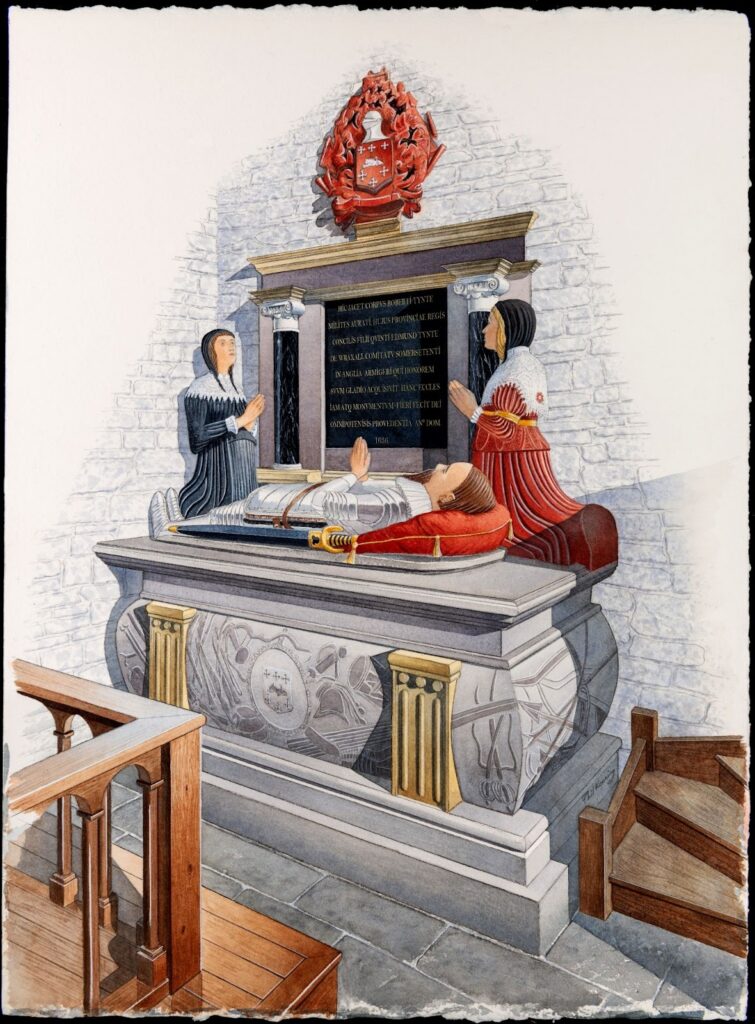
What was Sir Robert trying to reveal about himself? On the surface, he is presented as a C17th New English knight, sword by his side, surrounded by praying wives, a number of ‘trophies of war’ and his family’s ‘proud’ military tradition. The Tynte coat of arms appears twice. It tells the (possibly fabricated) story of an English ancestor who was knighted by King Richard the Lionheart ‘for the bravery of a lion and for having fought with the strength of six crusaders‘ at the Battle of Ascalon in 1192.
A written inscription proclaims that Sir Robert was the fifth son of Edmund Tynte of Wraxhall, Somerset. He arrived in Ireland towards the end of the 1500s or early 1600s at a time when the Munster Plantation offered young men who had little chance of social advancement in England an opportunity to become landowners in Ireland. He developed a close working relationship with Sir Richard Boyle, the 1st Earl of Cork, growing ‘wealthy and prosperous’ as a result (Berry, 1905, p. 42). But at whose expense?
Sir Robert helped to recruit other West Country settlers for the Earl of Cork’s Munster estates (Edwards & Rynne, 2017, p. 232 – 3). After being knighted, he was appointed Sheriff of Cork from 1625 – 26 and again from 1632 – 33 (Berry, 1905, p. 48). His tower house at Youghal became known as Tynte’s Castle. It was ideally located in the town as a secure base from which he could participate in and profit from the Munster Plantation. By 1638 Sir Robert was named as owner of ‘the Castle, Towns and Lands of Ballycrinan (Ballycrenane), Killcridan (Kilcredan), Gortneskibbole (Ballyskibbole) and Carrownebinny alias Carrowbin’.
Although his monument proclaims that Sir Robert was knighted for bravery in battle (Lee, 1926, p. 87), Edwards & Rynne (2017, p. 232 – 3) believe that ‘Captain Tynte was mainly notable for his role as master-muster of the plantation militia… As such, Tynte had authority over all the armed men of the province, their training, drilling and equipment…‘. Under his command, the Earl of Cork’s ‘private army’ was impressive. At Tallow in 1611 ‘[o]verseen and drilled by Captain Robert Tynte, it had the appearance of a professionally drilled army. Beneath Tynte there were five captains of horse…five captains of foot and even five drummers…While the gentlemen-horsemen all turned out on their best horses…the rank and file were no less well fitted out…186 men were equipped in the manner of standard early seventeenth-century infantrymen, with pikes, but it was…the remaining 250 foot soldiers that…set a standard that few could have matched. These were his army of ‘shot‘…provided with a gun and powder’ (Edwards & Rynne, 2017, p. 240). Not surprisingly, some of these weapons appear on his tomb.
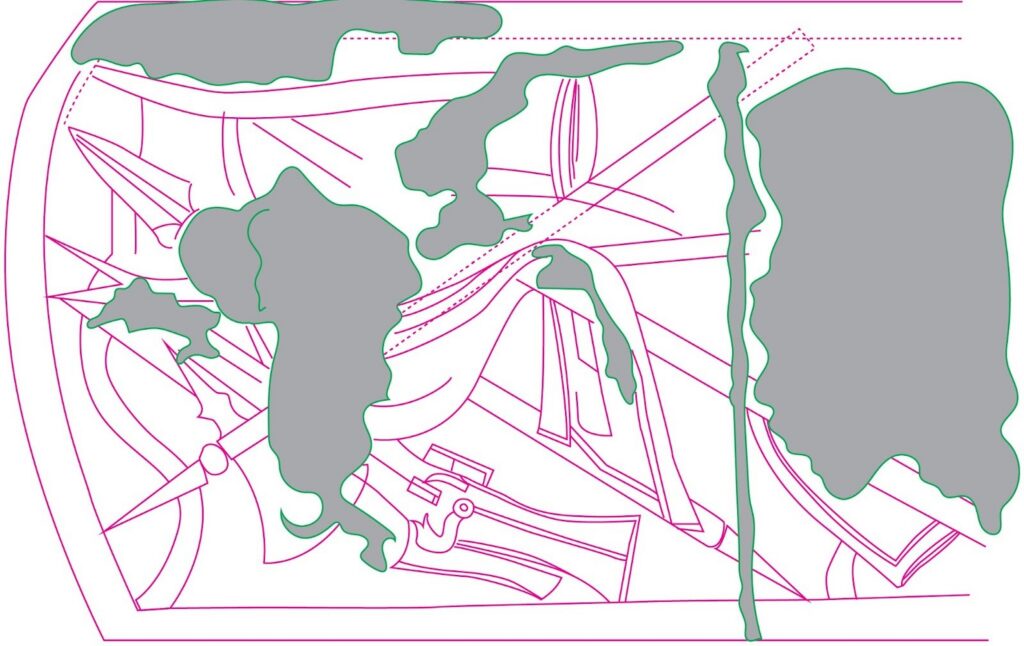
Harris (1999) revealed the following ‘trophies of war’ on the front of his sarcophagus: a priming flask, matchlock musket, furkets, wheelock pistols, oval shell guard, drum, cuirass, trumpets and banners, a possible bullet bag, a helmet, gauntlets, pikestaves and hilted swords with girdles. Lee (1926) and Roe (1977) identified additional carvings on the western side of the sarcophagus but Harris (1999) could no longer find any. She speculated that this was due to weathering on its more exposed side.
Such ‘trophies of war’ were standard motifs on Renaissance-era tombs in Britain and Ireland. They appear on the Fitzgerald tomb (1611) in Cloyne Cathedral, the Boyle monument in Youghal (1620s), the O’Connor monument in Sligo Abbey (1624) and on the tomb of Lord George Carew in Stratford-upon-Avon who died in 1629. Originally from Devon, Carew was appointed President of Munster in 1600 following the Earl of Essex’s failure to end rebellion in Ireland. On Carew’s sarcophagus, images of cannon, gunpowder barrels, cannonballs, a musket and a halberd are clearly visible. Other similarities with the Tynte monument include a family crest on top, marble pillars, a written inscription in the centre and effigies of a husband and wife at prayer. Although not very noticeable, the presence of two carved angels above and on either side of the praying couple offer us a clue to something greater than Carew’s military record. Can the same or similar be said of the Tynte monument?
In this regard, Herron (2023, p. 7) points to a deeper ‘religious and cultural messaging’ in the Tynte monument. For Herron (2023, p.23) the representation of Sir Robert’s praying wives, one at his head and another at his feet ‘evokes the two angels hovering over the tomb of Christ in the Gospel of St. John’. By retelling this aspect of the Easter story in Kilcredan, these women ‘hold open a space for us, for our death, for our sorrows’ to be transformed into something new (Herron, 2023, p.7). In this light, even the ‘trophies of war’ on the Tynte monument can no longer be viewed only as instruments of a New English ‘conquistador’, but as a reminder of ‘loves conquest’ over tragedy and death at Easter (Herron, 2023, p.14).
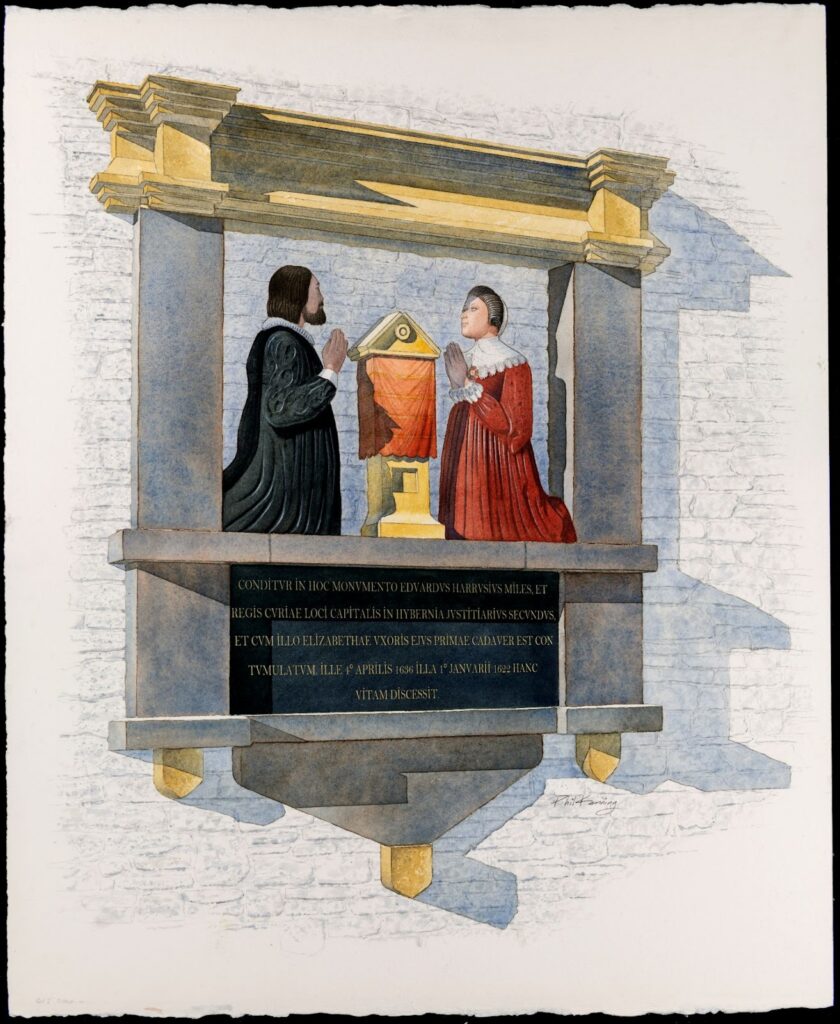
Sir Robert’s first wife, most likely Phillipa Harris, daughter of Sir Edward Harris, is represented at Sir Robert’s feet. In 1903, her effigy was described as that of a young woman kneeling ‘with hands folded in prayer…looking heavenwards with an expression of tender feeling that is quite affecting’ (Fleming, 1903, p. 156). Her dress is described as ‘a plain gown which falls in parallel pleats to her feet’ (Harris, 1999, p. 139).
A ‘kneeler monument’ to her father Sir Edward Harris and his wife Elizabeth Fowell is positioned directly opposite the Tynte monument in Kilcredan church. Such monuments are normally found in English cathedrals or large urban parish churches (Speel, B., 2018). Harris was born in Devon, became Chief Justice of Munster in 1608, MP for Clonakilty from 1613-15 and was knighted in 1619. Although buried at Kilcredan in 1636, it is likely that his remains were re-interred in his family tomb in St. Peter’s Church, Cornworthy, Devon.
Most likely, at Sir Robert’s head is Elizabeth Boyle, the ‘trophy wife’ (Herron, 2023, p.7) of Edmund Spenser, who, following Spenser’s death in 1599, married Capt. Robert Tynte at Youghal in 1612. In a letter to a relative, she states that she ‘found better contentment’ in this marriage (Joines-Newman, p. 3). This may have been due to the less stressful conditions that she enjoyed in east Cork compared to Kilcolman in North Cork from which she and Spenser fled following an Irish uprising there in the late 1500s.
Drawing on her attractiveness in Spenser’s love poetry, Joines-Newman has created an imaginary portrait for her. In the Tynte monument, however, the representation of her face appears to have been somewhat unremarkable, especially in comparison to Spenser’s glowing references to it. A 1926 photograph reveals what was likely to have been her sculpted head. Herron (2023, p. 2) thinks that this may now ‘be in a ditch or propping open a door on a nearby farm’. However, when one of the authors of this report was young, he heard a story that a head belonging to the Tynte monument was thrown into a stream that runs in front of the church. This may account for its disappearance. According to Lee (1926, p. 86) the appearance of Elizabeth Boyle was ‘more staid and matronly’ than that of Sir Robert’s first wife. However, Herron (2023, p.2) finds that the sculptor has ‘nicely captured a sense of movement’ in her ‘embroidered dress with a lace collar and Tudor style rose on its back and breast’. Similar floral decoration may be found on the breast of Elizabeth Fowell’s dress in the Harris monument.
The use of the Tudor rose is interesting given that the Stuart and not the Tudor dynasty were in power by 1636. Dress had played a role in Tudor state-building in England and by the early C17th this was extended to Ireland and Scotland where English dress was regarded as an indicator of status and civility. By contrast, native Irish dress was regarded as a sign of degeneracy (McGrath, 2018, p. 101-2). The Tynte and Harris monuments, therefore, were more than funerary monuments. They were part of a process of anglicisation in Ireland which was designed to pacify and secure the area.
In some other respects the Tynte monument differs from other C17th Irish and English funerary monuments. In the Carew monument, for example, the praying couple are represented as co-equal in death. Husband and wife lie side by side. In the Tynte monument, however, Sir Robert prays in the foreground while his wives pray behind him. Furthermore, Herron (2023, p.23) argues that one of the main differences between Elizabeth Boyle’s depiction in Spenser’s poetry with that of her in the Tynte monument is that, although possibly angelic in the Tynte monument, she is ‘reduced to a supporting role in eternity. She was Spenser’s, but apparently not Tynte’s, fairy queen’. Although Berry (1905, p.52) thought that she was buried with Sir Robert in Kilcredan, Herron (2023) thinks that we cannot be sure, especially given that she died before the monument was created.
On the surface, then, although Sir Robert presents himself as a knight, Herron (2023, p.23) suggests that he also humbly presents himself as a ‘wretched earthly clod’ that prays for ‘loves conquest’. Compare this with a reclining Sir Richard Boyle in the Boyle monument (Youghal), which shows his wives praying for him, although he doesn’t. Similarly, in the C17th Acland monument (Devon) while his wife prays for her husband, he reclines and observes the viewer! However, there is no suggestion in the Tynte monument that Sir Robert is praying for anyone other than himself and possibly for his wives.
The Process of Restoration
After Kilcredan Church was abandoned in c.1910, Lee (1926, p. 86) thought that a restoration of the Tynte monument was ‘now impossible’ due to its damaged condition. Consequently, when considering a reconstruction of this monument, we considered the possibility of a digital and artistic restoration. With this in mind, we approached Phil Kenning, a UK-based professional digital artist to see if he could help.
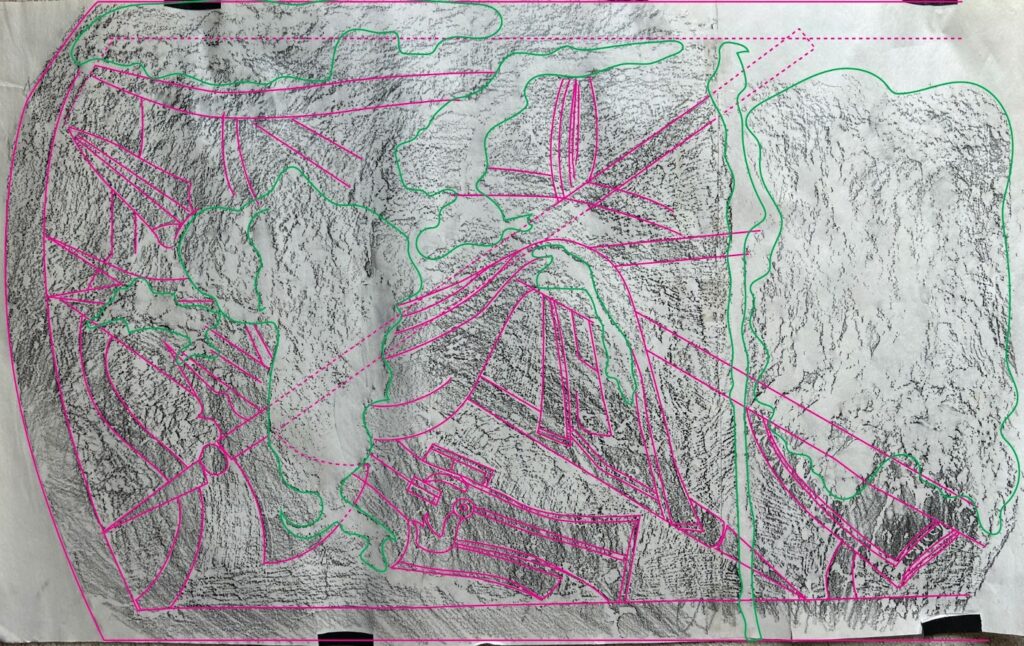
In May 2025, after completing a careful rubbing of the western side of the Tynte sarcophagus, a number of new ‘trophies of war’ came to light. With the assistance of Amy Harris, Stuart Kinsella (Christchurch, Dublin) and Prof. Thomas Herron (East Carolina University), the following were identified: a halberd (bottom left), musket (centre bottom), draped banner/flag and pole (centre), defensive pike/spear (top left) with shaft spike (bottom right) and a part of body armour edged with fur trim (bottom left). We also completed a rubbing of the Latin inscription (see next section). In both instances, the quality of craftsmanship that came through was remarkable.
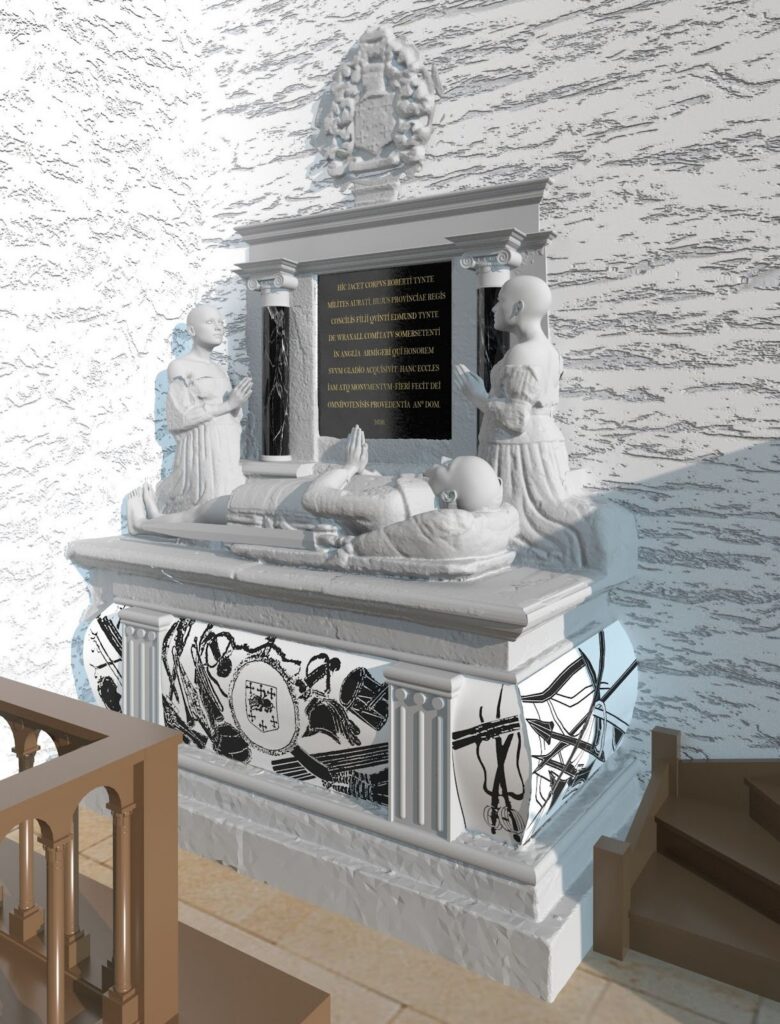
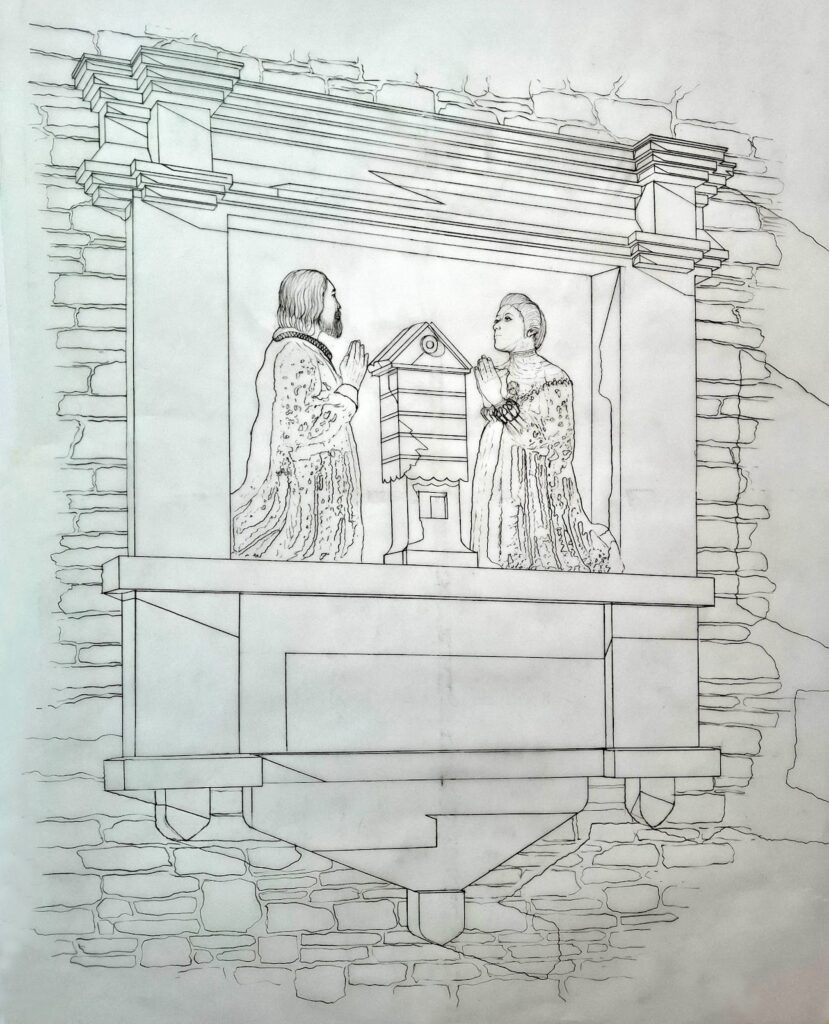
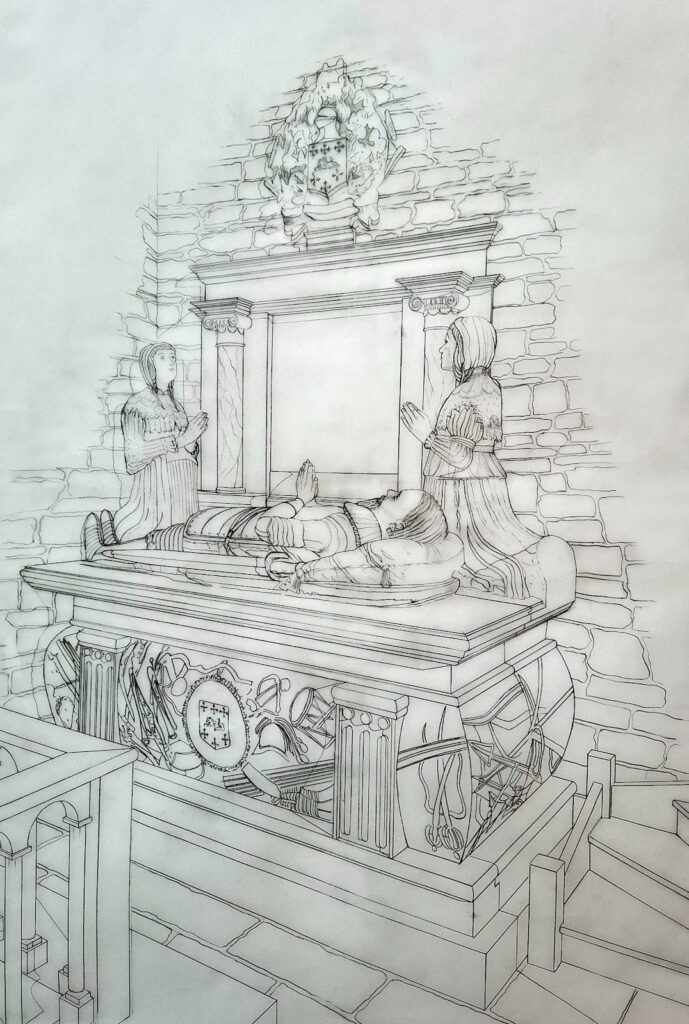
After being successfully awarded funding under Cork County Council’s Community Monuments Fund in March 2025, we commissioned Phil Kenning to undertake the following digital and artistic reconstructions of the C17th church interior and of the Tynte and Harris monuments:
- 3D CAD
- Line Drawings
- Watercolours
The corresponding images are presented in the next section.
Tynte Monument Rubbings

The Produced Images
3D CAD Stage Drawings


Pencil Stage Drawings

Watercolour Stage Drawings

Community Benefits
There are a number of ways that this project will ‘give back’. It is educational. It offers fresh insights into the culture of an almost forgotten C17th New English Protestant settler community. At the same time, it does not overlook attempts to dominate that were implicit in Sir Robert’s rebuilding project and in some of the messaging contained in the Tynte and Harris monuments. Tynte was commander of a colonial tenant militia whose main interest was their own safety and that of their social and economic advancement in the region (Clarke, McGrath and Edwards, 2025, p. xxiv). In turn, some dispossessed Catholics came to develop a self-identity as a ‘separate and injured community’ (Dickson, 2005, p.26). Resentment may have fuelled rebellion in the C18th and C19th. When the tide turned, the stories of Irish Protestants and their cultures didn’t fit well into a dominant C20th Irish Nationalist narrative which was struggling to come to terms with its own difficult past.
Such interwoven histories of domination, victimization and revolution are part of the history of the area. While they may help us to understand a complex past, for McLaren & Higgins (2019) only stories of reconciliation will serve us as we move into the future. An example of this was an event held at Kilcredan in June 2022 when local Anglicans & Catholics came together to pray in a place that is considered sacred to both (see image below). For O’Donoghue (1997, p. 41) such places are far from empty. They are ‘sacred spaces full of presence’. As local primary students in Kilcredan N.S. proceed to second-level, the C17th Plantation of Ireland and its effects are studied as part of their Junior Cycle History course. The 3D CAD reconstructions of the Tynte & Harris monuments and of the C17th church interior may be downloaded onto Sketchfab for use in the classroom in preparation for walking tours to Kilcredan church. A further possibility is to use the watercolour images on onsite information panels & on the BLCC Historical Group website so that international scholars may access these reconstructions from anywhere in the world.
Summary
We live in a historical moment whereby a new paradigm, one that calls for respect for each other, for the earth and for different ways of seeing and being is unfolding in our midst (McIntosh, 2008). With the help of a skilled artist such as Phil Kenning, we at BLCC Historical Group have been privileged to be part of this process. Phil’s delightful reconstructions not only help us to uncover and integrate a past richness, it refuses to allow us to forget that such richness came at a high price for those who felt marginalised and excluded from it. This project, then, helps us to come to understand the diversity and complexity of our interconnected heritages.
Acknowledgements
The authors would like to thank Tony Harpur, Conor Nelligan, Dr. Stuart Kinsella, Dr. Amy Harris, Dr. Clodagh Tait and Prof. Thomas Herron for their help with this project.

Bibliography
Berry, H.F. (1905) ‘Sheriffs of the County Cork – Henry III to 1660. Journal of the Royal Society of Antiquaries of Ireland’, Fifth Series, Vol. 35, No. 1.
Clarke, A., McGrath, B. and Edwards,D. (eds.) (2025) The Letterbook of Richard Boyle, 1st Earl of Cork, 1629-34. Irish Manuscripts Commission, Dublin.
Dickson, D. (2005) Old World Colony: Cork and South Munster 1630-1830. Cork University Press, Cork.
Maziere-Brady, W. (1863) Clerical and Parochial Records of Cork, Cloyne and Ross. Alexander Thom, Dublin.
McIntosh, A., (2008) Re-Kindling Community: Connecting People, Environment and Spirituality, Schumacher Briefing No. 15, Green Books, Devon.
McGrath, B., (2018) ‘Looking the part: dress and civic status and ethnicity in early modern Ireland.’ Journal of the Royal Society of Antiquaries of Ireland, Vol. 148, pp. 101-121.
Cork County Council, (2021) Heritage Artefacts of County Cork. Carrig Print.
Edwards, D. & Rynne, C. (2017) The Colonial World of Richard Boyle, First Earl of Cork. Four Courts Press, Dublin.
Harris, A.L (1999) ‘The Tynte Monument, Kilcredan, Co. Cork: A Reappraisal.’ Journal of the Cork Historical and Archaeological Society 104.
Herron, T. (2023) ‘Endless Moniment’: Elizabeth Boyle, Funerary Monuments and the Easter Message of Amoretti. The Spenser Review 53.2, Fall 2023.
Joines Newman, J. ‘Centering Elizabeth: Imagining Elizabeth Boyle in Art and Literature’, Centering Spenser: https://myweb.ecu.edu/herront/munster/objects/TH_P_portrait-EB.html (Accessed on 20/11/25).
Lee, P.G. (1926) ‘The Ruined Monuments of Sir Robert Tynte and Sir Edward Harris in Kilcredan Church, Ballycrenane, near Ladysbridge’. Journal of the Cork Historical and Archaeological Society, Vol. 31.
McLaren, B. (2024) ‘Befriending Nature. Fall in Love with a Place’. Centre for Action and Contemplation, Sept 6, 2024
McLaren, B. and Higgins, G. (2019) The Seventh Story: Us, Them and The End of Violence.
O’Donoghue, J. (1997) Anam Cara. Spiritual Wisdom in the Celtic World. Bantam Books, London.
Roe, H. (1977) ‘Addenda’, Journal of the Royal Society of Antiquaries of Ireland, Vol. 107.
Smith, C. (1750) The Ancient and Present State of the County and City of Cork… Vols. I & II, Guy & Co., Cork.
Speel, B. (2018) Kneeler Monuments speel.me.uk (Accessed on 03/10/24)
Leave a Reply